Architecture
Zatabase is a hybrid data and compute platform built in Rust. It combines relational SQL, NoSQL document storage, vector similarity search, and a job orchestrator in a single binary. This page describes the internal architecture and how the major components fit together.
High-Level Overview
Section titled “High-Level Overview”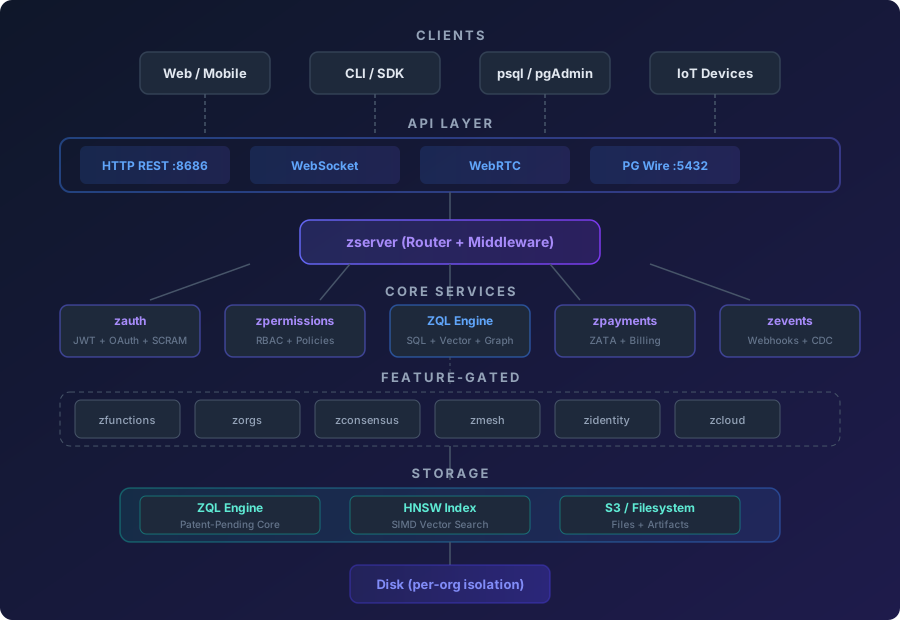
┌─────────────┐ │ Clients │ └──────┬──────┘ │ ┌────────────┼────────────┐ │ │ │ ┌─────▼─────┐ ┌───▼────┐ ┌─────▼─────┐ │ HTTP API │ │PG Wire │ │ WebRTC │ │ (Axum) │ │Protocol│ │ Real-time │ │ Port 8686 │ │Port 5432│ │ │ └─────┬──────┘ └───┬────┘ └─────┬─────┘ │ │ │ └────────────┼────────────┘ │ ┌──────▼──────┐ │ zserver │ │ (Router) │ └──────┬──────┘ │ ┌─────────────────┼─────────────────┐ │ │ │ ┌────▼─────┐ ┌─────▼──────┐ ┌──────▼──────┐ │ zauth │ │ ZQL │ │ zpayments │ │ (Auth) │ │ (Engine) │ │ (Credits) │ └────┬─────┘ └─────┬──────┘ └─────────────┘ │ │ ┌────▼─────┐ ┌─────▼──────┐ │zpermis- │ │ ZQL │ │ sions │ │ Patent- │ │ (RBAC) │ │ Pending │ └──────────┘ └─────┬──────┘ │ ┌─────▼──────┐ │ Storage │ └────────────┘ZQL Engine (Patent-Pending)
Section titled “ZQL Engine (Patent-Pending)”At the core of Zatabase is ZQL (Z Query Language), a patent-pending database engine that provides fast similarity search, exact matching, and SQL compatibility. ZQL is a separate, private codebase that Zatabase embeds as a library.
Key Capabilities
Section titled “Key Capabilities”- O(1) exact match: The
=operator provides instant exact matching - Prefix scans: The
STARTS_WITHoperator efficiently finds records by text prefix - Similarity search: The
~operator with a threshold parameter finds semantically related records - SQL compatibility: Standard SQL is auto-detected and executed through ZQL
- Dense f32 vectors: Standard floating-point vectors (any dimension) for ML embeddings, with L2, cosine, and inner product distance metrics
Crate Map
Section titled “Crate Map”Zatabase is organized as a Rust workspace with feature-gated crates:
Core Crates (Always Built)
Section titled “Core Crates (Always Built)”| Crate | Purpose |
|---|---|
zplatform-storage | KV API backed by the ZQL engine |
zcore-catalog | Table and column metadata management |
zauth | JWT authentication, OAuth, session management |
zpermissions | Role-based access control (RBAC) |
zpayments | ZATA ledger, escrow, and billing primitives |
zserver | Axum HTTP server, routes, streaming ingest |
zpg-protocol | PostgreSQL wire protocol implementation |
zobservability | Metrics, health checks, tracing |
zcommon | Shared types and utilities |
Feature-Gated Crates
Section titled “Feature-Gated Crates”| Crate | Feature Flag | Purpose |
|---|---|---|
zevents | events | Event system with webhooks and triggers |
zorganizations | organizations | Multi-tenant organization management |
zteams | organizations | Team collaboration and membership |
zfunctions | functions | Serverless function execution |
zdomains | domains | Custom domain management |
zprojects | projects | Project lifecycle management |
znotifications | notifications | Alert and notification delivery |
zsdk-generator | sdk-generator | Client SDK code generation |
zmesh-network | mesh | Peer-to-peer mesh networking |
zconsensus | consensus | Raft consensus for replication |
ztransaction | transactions | Distributed transactions and sagas |
zcloud-deploy | cloud | Cloud deployment automation |
zcloud-hetzner | cloud | Hetzner Cloud provider integration |
zcloud-cloudflare | cloud | Cloudflare integration |
zidentity | identity | Verifiable credentials and DID |
Storage Architecture
Section titled “Storage Architecture”All data in Zatabase flows through the ZQL engine. The platform storage layer (zplatform-storage) provides a key-value API on top of ZQL for metadata and configuration:
Application Code │ ▼zplatform-storage (KV API) put_json / get_json / scan_prefix_json / delete │ ▼ZQL Engine (patent-pending) query / insert / exact_lookup / prefix_scan / execute_sql │ ▼Disk (data_dir/<org_id>/<store_name>/)Each organization gets isolated storage directories. Within an organization, data is partitioned by store (table) name.
Security Model
Section titled “Security Model”Authentication
Section titled “Authentication”Zatabase uses a layered authentication system:
- JWT tokens: Short-lived access tokens (15 min default) + long-lived refresh tokens (7 days)
- SCRAM-SHA-256: For PostgreSQL wire protocol connections
- Dev tokens: HMAC-signed tokens for development (blocked in production)
- OAuth: Delegated authentication via Google, GitHub, Discord, Apple
Authorization (RBAC)
Section titled “Authorization (RBAC)”Permissions are enforced at API boundaries using org-scoped role-based access control:
- Principals: Users, Roles, Groups, Labels
- Resources: Collections, Tables, Indexes, Jobs, Files, Permissions
- Actions: Create, Read, Update, Delete
- Built-in roles:
admin(full access),operator(read/write data),reader(read-only)
Permission checks are applied by every handler before executing operations:
fn ensure_permission( org_id: u64, principals: &[Principal], resource: ResourceKind, action: Crud,) -> Result<(), PermissionError>Multi-Tenancy
Section titled “Multi-Tenancy”- Every request is scoped to an organization via the JWT token
- Storage is physically isolated per org (separate directories)
- Permissions are evaluated per-org
- Environment isolation (live/sandbox) provides logical separation within an org
Real-Time Communication
Section titled “Real-Time Communication”WebSocket
Section titled “WebSocket”Zatabase supports WebSocket connections for real-time event streaming:
- Topic-based pub/sub (subscribe to job updates, data changes)
- Bounded message queues with backpressure (256 message capacity)
- Concurrent connection handling with graceful cleanup
WebRTC
Section titled “WebRTC”For low-latency data channel communication:
- Room-based signaling with ICE trickle support
- Query execution over data channels (SQL and QueryBuilder)
- Real-time metrics, logs, and event forwarding
- Database trigger notifications
Consensus and Replication
Section titled “Consensus and Replication”When the consensus feature is enabled, Zatabase uses Raft consensus to replicate write operations across cluster nodes:
- Write operations are proposed to the Raft leader
- The leader replicates to a majority before committing
- Read operations go directly to the local engine
- A
CompositeStateMachineroutes operations to the appropriate subsystem
Job Orchestration
Section titled “Job Orchestration”Zatabase includes a built-in job orchestrator (zbrain + zworker) for compute tasks:
- Submit job specifications via REST API
- Jobs execute as native processes (local mode) or containers (Docker mode)
- Real-time log streaming via WebSocket
- Artifact management with content-addressed filesystem storage
- Cancellation support with configurable timeouts
Build Configuration
Section titled “Build Configuration”Zatabase uses feature flags to control which subsystems are compiled:
# Core only (minimal binary)cargo build -p zserver --no-default-features --features core
# V1 build (production release)cargo build -p zserver --features v1
# Full build (all features including post-V1)cargo build -p zserver --features full
Feature Profiles
Section titled “Feature Profiles”v1 (production release): core, websocket, webrtc, events, organizations, consensus, tls, security-hardening, cypher, pg-tunnel, mesh, cloud, functions, projects.
full (all features): Everything in v1 plus identity, transactions, domains, notifications, sdk-generator, integrations.
Individual Feature Flags
Section titled “Individual Feature Flags”| Flag | Description |
|---|---|
core | Database essentials (always included) |
websocket | WebSocket real-time event streaming |
webrtc | WebRTC data channels for low-latency queries |
events | Event system with webhooks and triggers |
organizations | Multi-tenant org and team management |
consensus | Raft consensus for replication |
tls | TLS termination for HTTP API |
security-hardening | Argon2id key management, X.509 cert gen, compliance |
cypher | Cypher graph query language support |
pg-tunnel | PostgreSQL wire protocol with TLS tunnel |
mesh | Peer-to-peer mesh networking |
cloud | Cloud deployment (Hetzner, Cloudflare) |
functions | Serverless function execution |
projects | Project lifecycle management |
identity | Verifiable credentials and DID (post-V1) |
transactions | Distributed transactions and sagas (post-V1) |
domains | Custom domain management (post-V1) |
notifications | Alert and notification delivery (post-V1) |
sdk-generator | Client SDK code generation (post-V1) |
integrations | Cross-service routing (post-V1) |
s3-storage | S3-compatible file storage backend |